
Imagine buying a brand-new Ferrari. It’s powerful, sleek, and engineered for speed. Now, imagine driving that Ferrari exclusively on a dirt road full of potholes. No matter how much you paid for the engine, you are never going to reach top speed.
This is exactly what happens to many businesses today. You pay for Gigabit fiber internet and buy top-of-the-line computers, but if your internal office wiring is outdated or disorganized, you are throttling your own performance. This “dirt road” leads to slow office network speed, buffering during critical video calls, and endless frustration.
In this post, we will uncover the structured cabling benefits that form the hidden backbone of a productive, modern workplace and why your physical infrastructure matters just as much as your software.
What is Structured Cabling? (It’s More Than Just Wires)
If you’ve ever looked into a server closet and seen a “spaghetti mess” of tangled, unlabeled blue and yellow wires hanging from the ceiling, you’ve seen point-to-point cabling. It is chaotic, fragile, and a nightmare to fix.
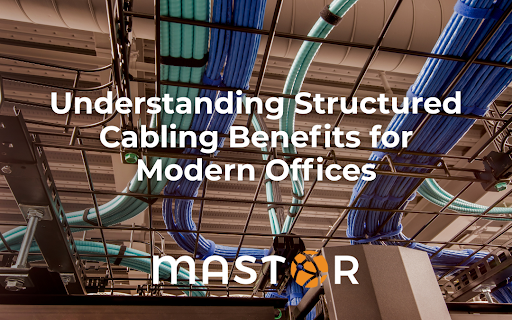
Structured cabling is the opposite. It is a standardized architecture for your network infrastructure. It organizes your building’s telecommunications cabling into distinct subsystems—like patch panels, horizontal cabling, and work area outlets. It turns the chaos of wires into an organized, manageable system where every cable has a purpose and a place.
The Top Structured Cabling Benefits for Your Operations
Investing in a professional installation isn’t just about tidiness; it’s a strategic business decision. Here are the key structured cabling benefits that directly impact your bottom line.
1. Scalability and Future-Proofing
In a non-structured environment, adding a new employee often means running a new, long cable across the drop ceiling or along the floor. With a structured system, the infrastructure is already there. You can easily add new devices, phones, or workstations without disrupting daily operations. It allows your network to grow alongside your business without requiring a complete overhaul every few years.
2. Reduced Downtime and Easier Troubleshooting
Time is money. When a port fails in a “spaghetti” mess, an IT technician might spend hours just tracing the cable to find the break. With a structured system, ports are color-coded and labeled on a patch panel. Identifying and fixing a bad connection takes seconds, not hours, drastically reducing costly downtime.
3. Aesthetics and Safety
Professional voice and data cabling looks clean and professional. But beyond aesthetics, organization improves airflow in your server racks, preventing equipment from overheating. It also eliminates the dangerous trip hazards caused by loose cables snake-ing under desks and across walkways.
The Speed Limit: Cat6 vs Cat5e
If you are moving into an older office building, the existing cabling might be your biggest bottleneck. Many older structures still rely on Cat5e (Category 5e) cables.
Here is the breakdown of the Cat6 vs Cat5e dilemma:
- Cat5e: This was the standard for years. It is generally good for basic tasks and tops out at 1 Gigabit per second (Gbps). However, it relies on thinner wires and is more prone to interference (crosstalk) from other electrical devices.
- Cat6/Cat6A: This is the modern standard for new installations. It features tighter twists and better shielding, allowing for data transfer speeds up to 10Gbps over shorter distances.
If your team relies on high-definition Zoom calls, large file transfers, or cloud-based applications, sticking with Cat5e is like putting a speed limiter on your network. Upgrading to Cat6 is a non-negotiable investment in your network infrastructure to ensure you get the speeds you are paying your ISP for. You can learn more about the technical differences here.
Why Professional Installation is Critical
It is tempting to ask a general handyman or an electrician to “run a few ethernet lines” during a renovation, but this is often a mistake. Data cables are sensitive. Running them too close to electrical lines can cause interference that kills your office network speed, and bending them too sharply can break the internal copper.
At Mastor Telecom, we specialize in Voice & Data Cabling. We don’t just plug cables in; we test every line to ensure it meets industry standards for speed and reliability. Whether you need a simple upgrade or a full office build-out, our integrated solutions ensure your physical cabling supports your VoIP and Phone Systems seamlessly.
Don’t Let Bad Cabling Throttle Your Growth
The structured cabling benefits are clear: higher speeds, easier troubleshooting, and a safer, more professional work environment. Don’t let your business’s potential get tangled up in a mess of bad wiring.
Is your server room a mess of tangled wires? Are you suffering from unexplained slow network speeds? Contact Mastor today for a site survey and professional cabling assessment.